Comparison · Infrared Saunas
Infrared Sauna with Red Light Therapy: Built-in vs Add-on Panels
Red light saunas compared: built-in cabins vs add-on panels, real wavelengths and LED counts, 30A and 240V wiring, prices, evidence and who should skip it.
HeatColdLab is reader-supported and may earn a commission from links on this page. We do not physically test saunas or measure light output; see How We Review.
“Red light sauna” is one of the fastest-growing searches in home wellness, and one of the most confusing. Plenty of cabins advertise “red light therapy” when what they actually have is a red chromotherapy LED strip in the ceiling. Others have serious, purpose-built LED panels with published wavelengths and irradiance.
Below we explain how heat and red light differ, compare built-in red light cabins with add-on panels, walk through the wiring (that’s where most of the surprise cost hides) and sum up what the research supports. Specs and prices come from manufacturer pages and spec sheets checked in November 2026. We haven’t used or measured these products ourselves. Our bias, stated plainly: for most people an add-on panel is better value than a built-in system, and we explain why below.
Heat vs photobiomodulation
These are two different mechanisms that happen to share a word:
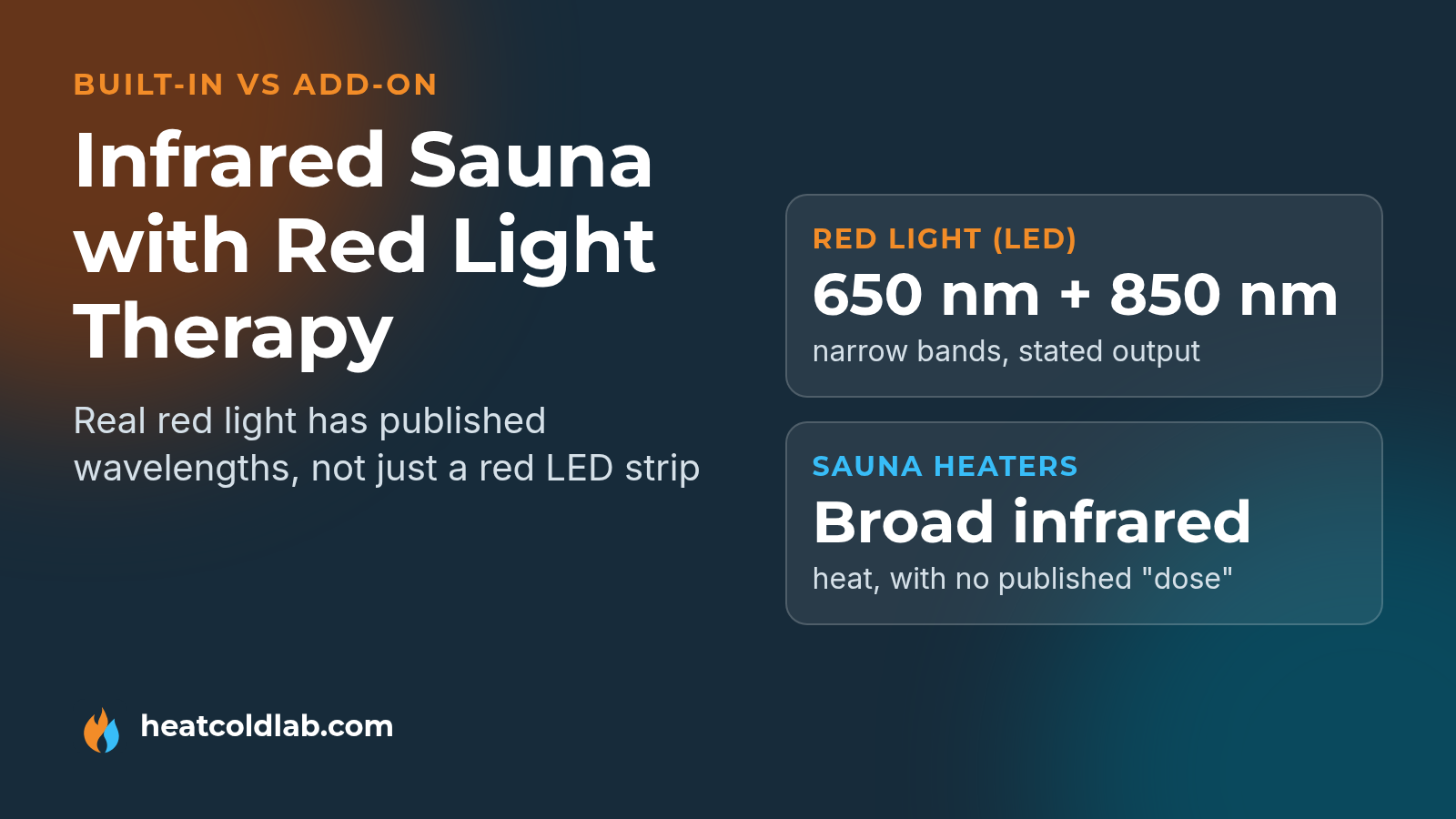
- Infrared sauna heat. Carbon and full-spectrum heaters warm your body and the cabin air. The goal is a rise in body temperature and a sweat. Heaters do not publish a “dose.”
- Red light therapy (photobiomodulation, PBM). LEDs or lasers deliver narrow bands of visible red (roughly 630–670 nm) and near-infrared (roughly 810–880 nm) light at a measured irradiance (mW/cm²) for a set time. The proposed mechanism is a cellular response to light, especially in mitochondria, not heating (Avci et al., 2013).
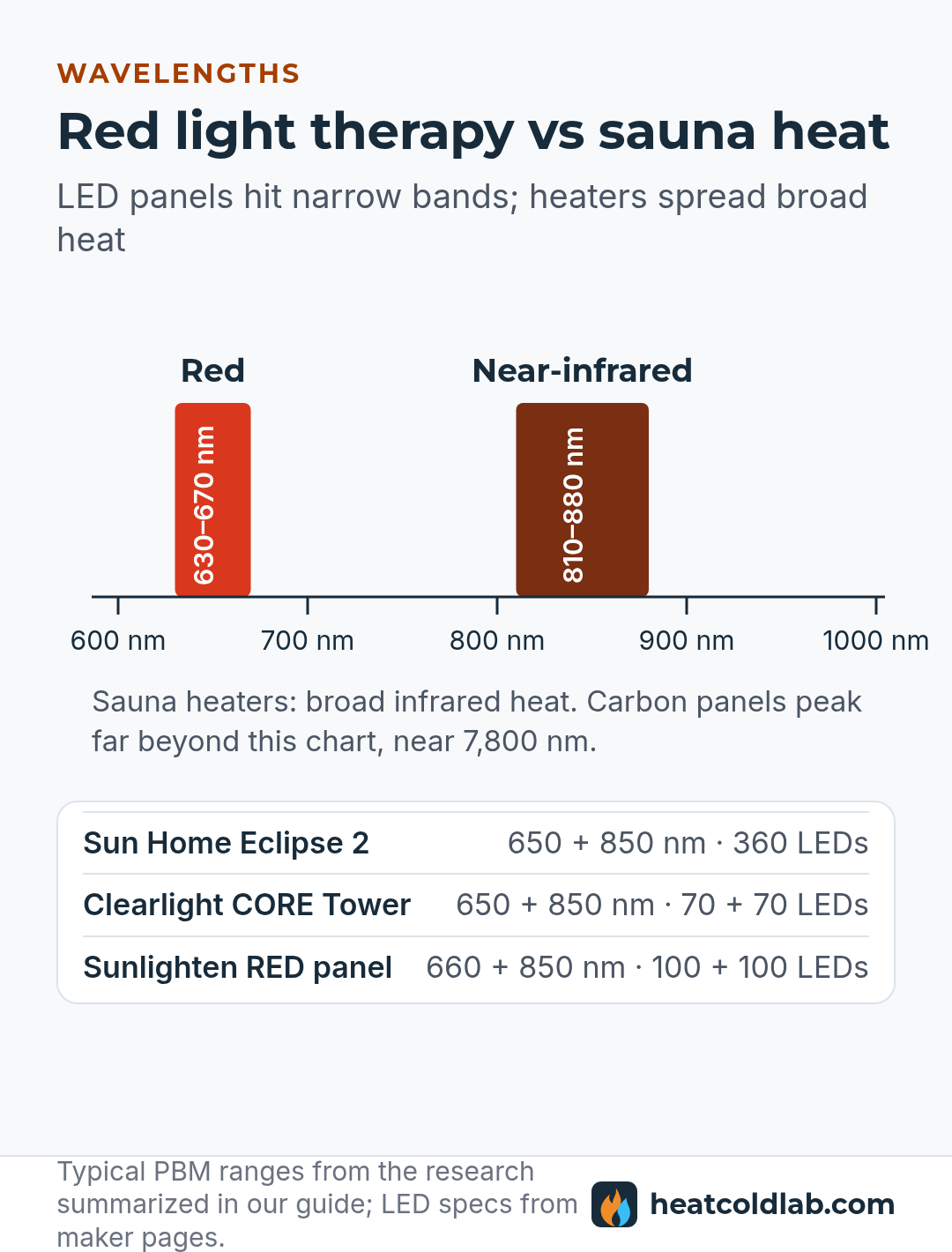
Because PBM is dose-dependent, the useful specs for a red light panel are wavelength, LED count, irradiance at a stated distance and recommended session time. If a sauna listing gives you none of those, assume it is chromotherapy (colored lighting for mood), not therapy. Chromotherapy is fine; it is just not the same thing.
A practical tip: irradiance falls quickly as you move away from the LEDs. Clearlight’s CORE Tower spec sheet lists approximately 55–110 mW/cm² at 4 inches. Sun Home recommends sitting 6–24 inches from its Eclipse panels. Where you sit in the cabin changes the dose you get.
Built-in red light cabins
| Model | Red light system (per maker) | Heaters | Electrical | Price (Nov 2026) |
|---|---|---|---|---|
| Sun Home Eclipse 2 | 2 panels, 360 LEDs, dual 900W, 650 nm + 850 nm | 5 FIR + 1 FIR floor + 2 full spectrum | 120V, 23.5A; dedicated 30A GFCI, NEMA L5-30 | around $9,799 |
| Sun Home Eclipse 4 | Same dual-panel system | 12 FIR + 2 floor + 4 full spectrum | 240V, 22A; dedicated 30A, NEMA L6-30 | around $12,799 |
| Sun Home Pod (1-person) | Integrated red light (see maker specs) | 10 FIR | Dedicated 20A GFCI, NEMA 5-20 | around $6,499 |
| Sunlighten Amplify II RED | 4 near-infrared “Red Light” heaters | 4 FIR + 3 full spectrum | 240V, 2,620W, 10.92A; dedicated 240V/20A, NEMA 6-20R | around $7,899 |
| Sunlighten mPulse (Believe, 2-person) | Red light as a programmable wavelength | Smart full spectrum | Dedicated 120V/20A (Believe) | by quote |
Sun Home Eclipse 2: best built-in for two
About $9,799 on sale in November 2026 (list $10,599). See the Eclipse 2 at Sun Home
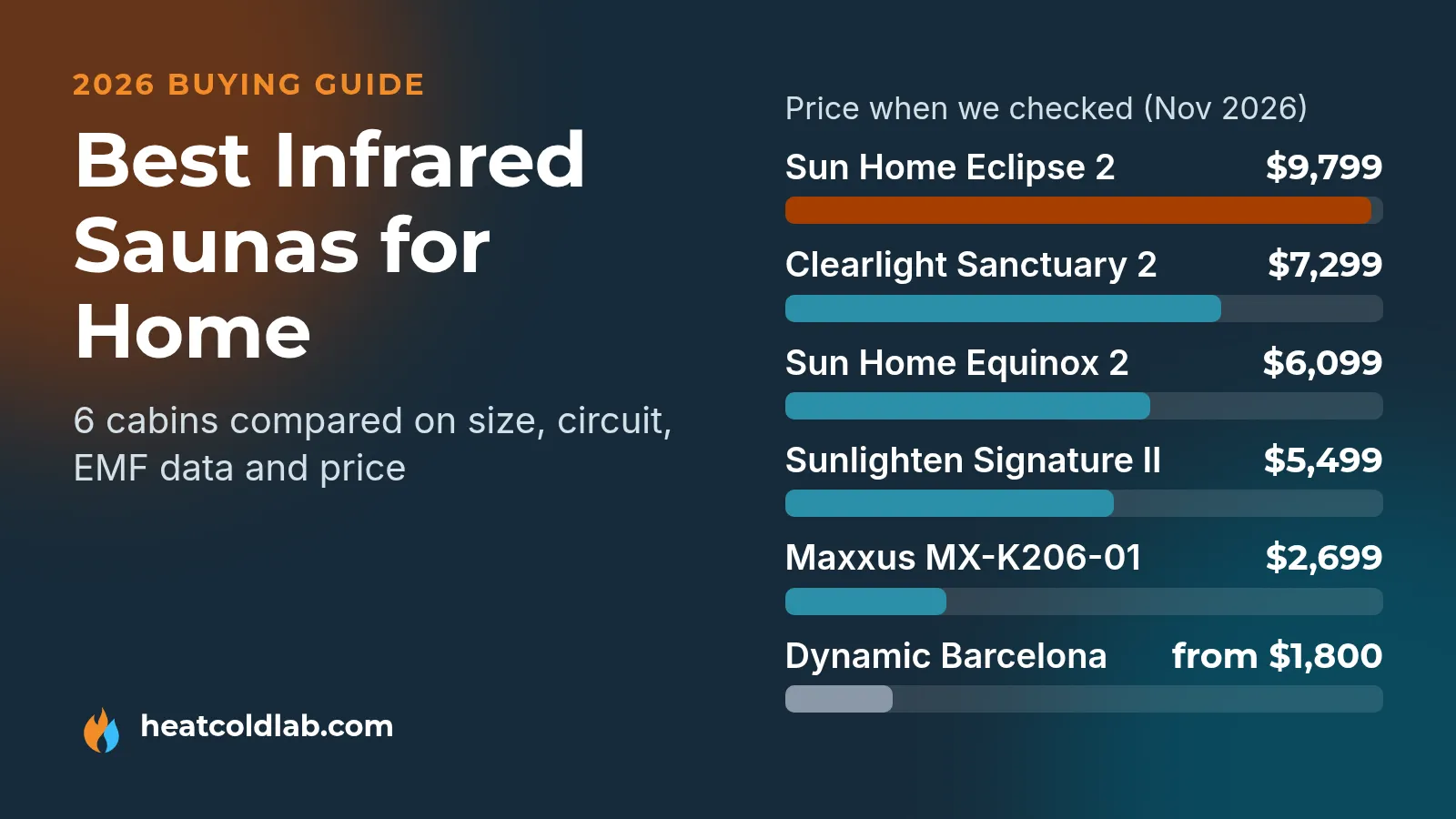
The Eclipse 2 is the most transparent built-in red light cabin we found. Sun Home’s user guide specifies two red light panels with 360 LEDs and dual 900W output at 650 nm and 850 nm, controllable separately (red only, near-infrared only or both) with their own timer. Sun Home recommends 20 minutes at least three times a week at 6–24 inches. The cabin itself is Japanese cedar, with eight infrared heaters and a 165°F maximum.
Downsides: it is expensive, the interior is 42.8 inches wide (slightly narrower than many 2-person cabins), and it needs a dedicated 120V/30A circuit with a NEMA L5-30 twist-lock and GFCI breaker. Sun Home also notes its red light panels are not FDA-approved to diagnose, treat or cure any condition and are for general wellness use. We’d only pay the premium if you know you’ll actually sit facing those panels most sessions.
Sunlighten Amplify II RED: built-in, lower price, 240V
About $7,899 on sale in November 2026 (list $8,899). See the Amplify II RED at Sunlighten
Sunlighten’s version adds four near-infrared red light heaters to an Amplify II shell with four far-infrared and three full-spectrum heaters. The product page we reviewed did not list exact wavelengths or irradiance for those red light heaters, so ask Sunlighten for them before buying if dose matters to you. It needs a dedicated 240V/20A circuit (NEMA 6-20R), which costs about the same to install as a 120V/20A circuit if your panel has room, but cannot share a standard outlet.
Sunlighten mPulse: programmable wavelengths
Sunlighten’s mPulse line delivers red, near, mid and far infrared as separately programmable bands through a tablet controller. Sunlighten sells it by quote. In October 2026 one Sunlighten affiliate store listed the two-person Believe at $8,699, so expect a price in that range before promotions.
Add-on red light panels
If you already own a sauna, or you want to choose your own panel, an add-on can deliver similar wavelengths for a fraction of the cost.
| Add-on | Specs (per maker) | Fits | Price (Nov 2026) |
|---|---|---|---|
| Clearlight CORE Tower | 70 red LEDs (650 nm) + 70 NIR LEDs (850 nm); 200W; 100–240V; ~55–110 mW/cm² at 4”; 15 lbs; door mounts included | Clearlight saunas (offered as Sanctuary upgrade) | around $1,399 as Sanctuary add-on (list $1,999) |
| Sun Home Red Light Therapy Luminar Add-on | Red light upgrade for Luminar outdoor cabins | Sun Home Luminar 2 and 5 | around $1,699 |
| Sunlighten RED Light Therapy Panel | 200 LEDs (100 red at 660 nm, 100 NIR at 850 nm); 35” x 11” x 2.76”; 22 lbs; 3-yr residential warranty | Standalone panel (check heat rating before in-sauna use) | around $1,379 |
Clearlight CORE Tower: best add-on for an existing cabin
See the CORE Tower at ClearlightClearlight publishes the CORE Tower’s LED count, wavelengths, wattage and approximate irradiance, which is more than most sauna red light products disclose. Paired with a Sanctuary 2 (around $7,299), the total is roughly $8,700, about $1,100 less than an Eclipse 2, with a roomier cabin. The trade-off is wiring and convenience: see the circuit section below.
Sun Home Luminar + red light: the outdoor option
For “outdoor infrared sauna with red light therapy,” Sun Home’s Luminar 2 (around $10,799, outdoor, Canadian red cedar, 170°F max) offers red light as an optional upgrade (about $1,699 when we checked). Luminar cabins need 240V: the Luminar 2 requires a dedicated 240V/20A circuit with a NEMA L6-20 receptacle. See the Luminar red light add-on
Standalone panels
Standalone red light panels like Sunlighten’s RED Light Therapy Panel (around $1,379) are designed primarily for use outside the sauna. Before mounting any panel inside a hot cabin, confirm with the maker that it is rated for sauna temperatures; LEDs generally lose efficiency and age faster when hot. Many owners simply use a panel after the sauna session instead. See the Sunlighten panel
Circuit impact (often 30A)
Red light adds real electrical load, and this is the most common surprise for buyers:
- Sun Home Eclipse 2: 2,820W at 120V (23.5A), dedicated 30A circuit with GFCI breaker and NEMA L5-30 twist-lock receptacle.
- Sunlighten Amplify II RED: 2,620W at 240V (10.92A), dedicated 240V/20A circuit, NEMA 6-20R.
- Clearlight Sanctuary 2 + CORE Tower: Clearlight’s spec sheet gives two options to run both at once: one 30A outlet (NEMA 5-30P, 10 AWG wire) for both, or the sauna on its own 20A outlet and the tower on a separate 15A circuit. If you add Clearlight’s upgraded heater too, only the 30A option is compatible.
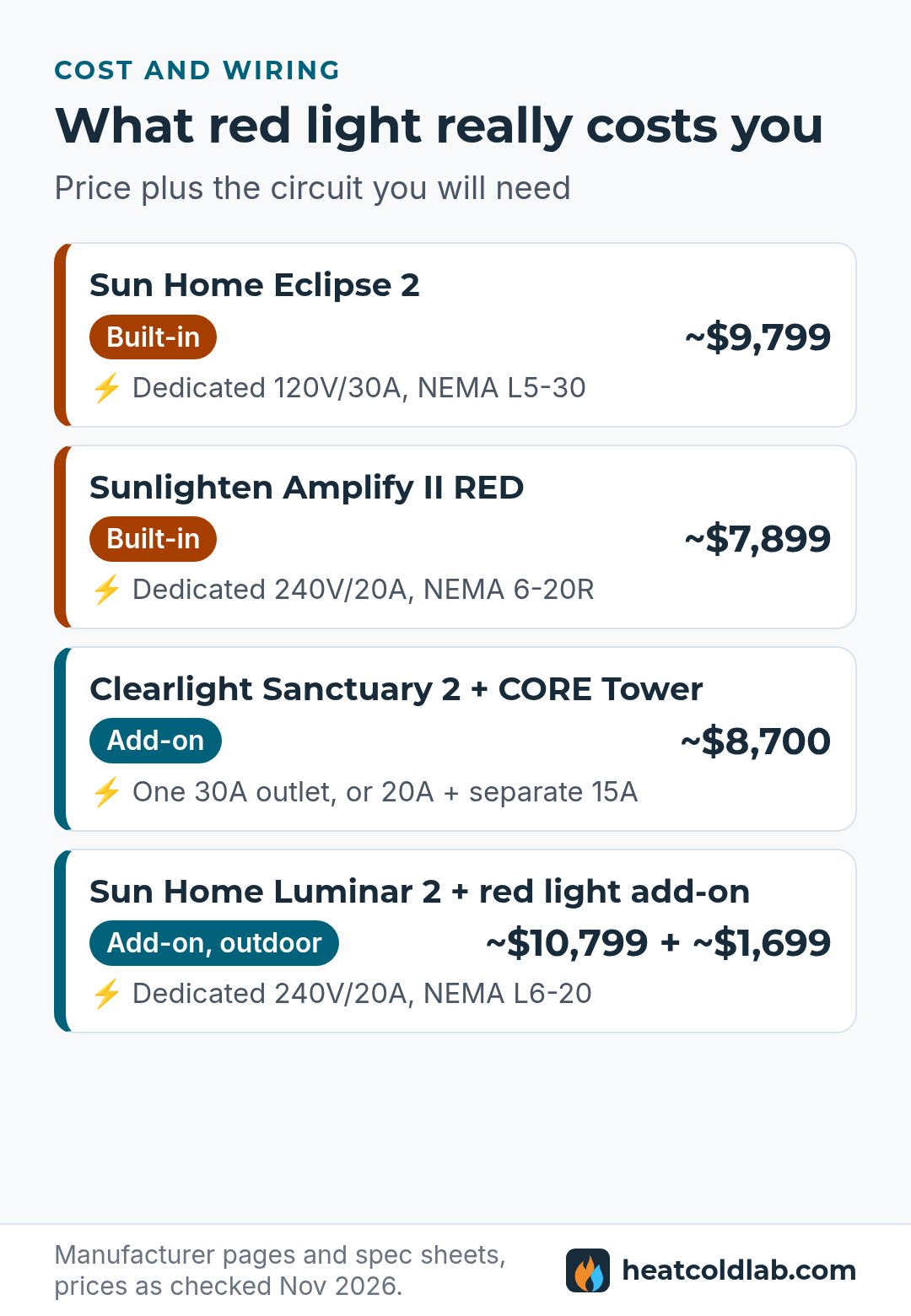
Plan this before your electrician visits. Angi’s 2026 national average for a dedicated circuit is about $700, so wiring once instead of twice is real money. Full details are in our infrared sauna electrical guide.
What the research says about red light
Red light therapy has a growing body of research, but results depend heavily on wavelength, dose and protocol, and most studies did not take place inside a hot sauna.
- Skin: In a controlled trial of 136 volunteers, twice-weekly treatment with red or broadband red/near-infrared light for 30 sessions improved skin complexion, skin roughness and ultrasound-measured collagen density compared with controls. Worth noticing: the broader spectrum showed no advantage over red-only light (Wunsch & Matuschka, Photomedicine and Laser Surgery, 2014).
- Muscle performance and recovery: A 2015 systematic review and meta-analysis found phototherapy with lasers and LEDs improved some muscular performance measures and markers of recovery, with the most consistent results from red or near-infrared wavelengths, mostly when applied before exercise. The pooled gains were small: about 4 seconds longer to exhaustion and about 5 more repetitions (Leal-Junior et al., Lasers in Medical Science, 2015).
- Mechanism and skin applications overview: A widely cited review summarizes proposed mechanisms and dermatology uses, while noting that dosing parameters vary widely across studies (Avci et al., 2013).
What we could not find: controlled trials showing that combining red light with infrared sauna heat in one session produces better outcomes than either alone. Combining them is about convenience, not proven synergy. That’s fine, as long as you’re paying for convenience on purpose.
Who should skip red light in a sauna
- People with photosensitivity or taking photosensitizing medications (ask your doctor or pharmacist).
- Anyone pregnant, with heart disease, epilepsy, a pacemaker or metal implants: Sun Home’s guide says to consult a physician first.
- Budget buyers: a well-documented far-infrared cabin plus a separate panel later may cost less than a built-in system now. See our best infrared saunas for home and full spectrum vs far infrared guides.
- People who mainly want heat: if you would never sit facing a panel, you will not use it.
Eye safety matters too. Sun Home’s guide warns against staring into the panels, and notes that wearing goggles with heaters on limits visibility and increases the risk of touching hot surfaces, so sit down and position yourself before putting goggles on.
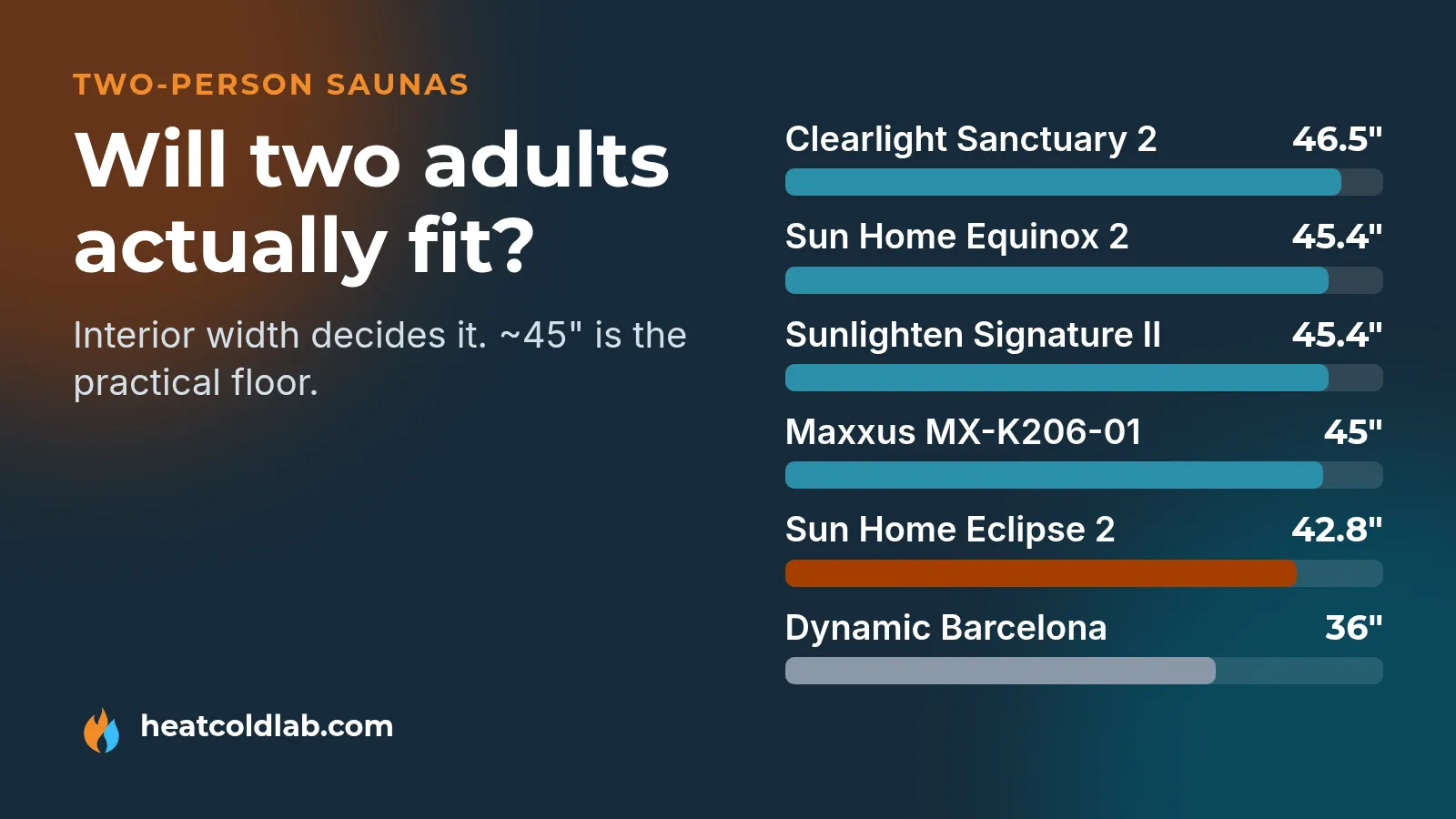
For 2-person red light cabins specifically, compare interior width in our best 2-person infrared saunas guide. LED drivers are also an EMF source; our low-EMF guide explains what to ask.
FAQ
Is a red light sauna the same as an infrared sauna?
No. An infrared sauna heats you with infrared heaters. Red light therapy (photobiomodulation) uses LEDs at specific red and near-infrared wavelengths, usually around 630–670 nm and 810–880 nm, at a stated output. Some cabins combine both, but they are separate systems.
What is the best infrared sauna with red light therapy?
For a fully integrated 2-person cabin, the Sun Home Eclipse 2 (around $9,799 in Nov 2026) is the most fully specified we found: two panels with 360 LEDs at 650 nm and 850 nm. The Sunlighten Amplify II RED (around $7,899) is cheaper but needs a 240V/20A circuit.
Can I add red light therapy to my existing sauna?
Often, yes. Clearlight sells its CORE Tower (70 red LEDs at 650 nm and 70 near-infrared LEDs at 850 nm) as a sauna add-on, and Sun Home sells a red light add-on for its outdoor Luminar. Check that the panel is rated for sauna heat and that you have the electrical capacity.
Does adding red light to a sauna change the electrical requirements?
Usually. The Sun Home Eclipse 2 needs a dedicated 120V/30A circuit (NEMA L5-30). Clearlight’s spec sheet says running the Sanctuary 2 with a CORE Tower requires either one 30A outlet or a separate 15A circuit for the tower.
Does red light therapy actually work?
There is promising but mixed evidence. Controlled trials show modest improvements in skin roughness and collagen density, and a 2015 meta-analysis found phototherapy improved some muscle performance measures. Effects depend on wavelength, dose and distance, and none of this makes red light a medical treatment.
Who should avoid red light therapy in a sauna?
Sun Home’s guide advises consulting a physician first if you have photosensitivity disorders, a pacemaker, metal implants, heart disease, epilepsy or are pregnant. People on photosensitizing medications should also ask a doctor. Never stare into the LEDs.
Did you test these red light saunas?
No. HeatColdLab does not physically test saunas or measure irradiance. We compare published wavelengths, LED counts, irradiance figures, electrical specs, warranties and owner reviews. See How We Review.
Sources
- Sun Home: Eclipse 2 product page, Eclipse user guide (red light specs, safety), Full-spectrum collection (electrical), Luminar red light add-on, Luminar 2
- Sunlighten: Amplify II RED, RED Light Therapy Panel
- Clearlight: CORE Tower, CORE Tower spec sheet (PDF), Sanctuary 2 spec sheet with wiring options (PDF), price list
- mPulse pricing reference: Sauna Monthly, mPulse Believe (Oct 2026)
- Angi: Cost to install a dedicated circuit (2026)
- Research: Wunsch & Matuschka 2014 (PMID 24286286); Leal-Junior 2015 (PMID 24249354); Avci 2013 (PMID 24049929)