Guide · Infrared Saunas
Infrared Sauna Electrical Guide: 15A vs 20A vs 240V (Dedicated Circuit)
Which circuit does your infrared sauna need? Plug types, dedicated 20A and 30A circuits, 240V models, electrician costs and the warranty traps to avoid.
HeatColdLab is reader-supported and may earn a commission from links on this page. We are not electricians, and this guide is not a substitute for a licensed electrician and your local code. See How We Review.
Electrical requirements are the most overlooked line on an infrared sauna spec sheet. They’re also how some buyers end up with a $6,000 cabin they can’t switch on for two weeks while they wait for an electrician. The fix is boring but simple: read four numbers before you order, and get a quote before delivery day.
We built this guide from manufacturer spec sheets, installation manuals and electrician cost data checked in November 2026. We’re not electricians, so think of it as homework for the conversation with yours. Your electrician and local code have the final word.
Read your breaker (and your spec sheet) first
Every infrared sauna spec sheet lists some combination of:
- Voltage: 120V (standard U.S. household) or 240V (the same supply used by dryers and ranges).
- Watts and/or amps: amps = watts ÷ volts. Sun Home lists the Equinox 2 at 1,880W and 15.67A at 120V; Clearlight lists the Sanctuary 2 at 2,260W and 18.83A.
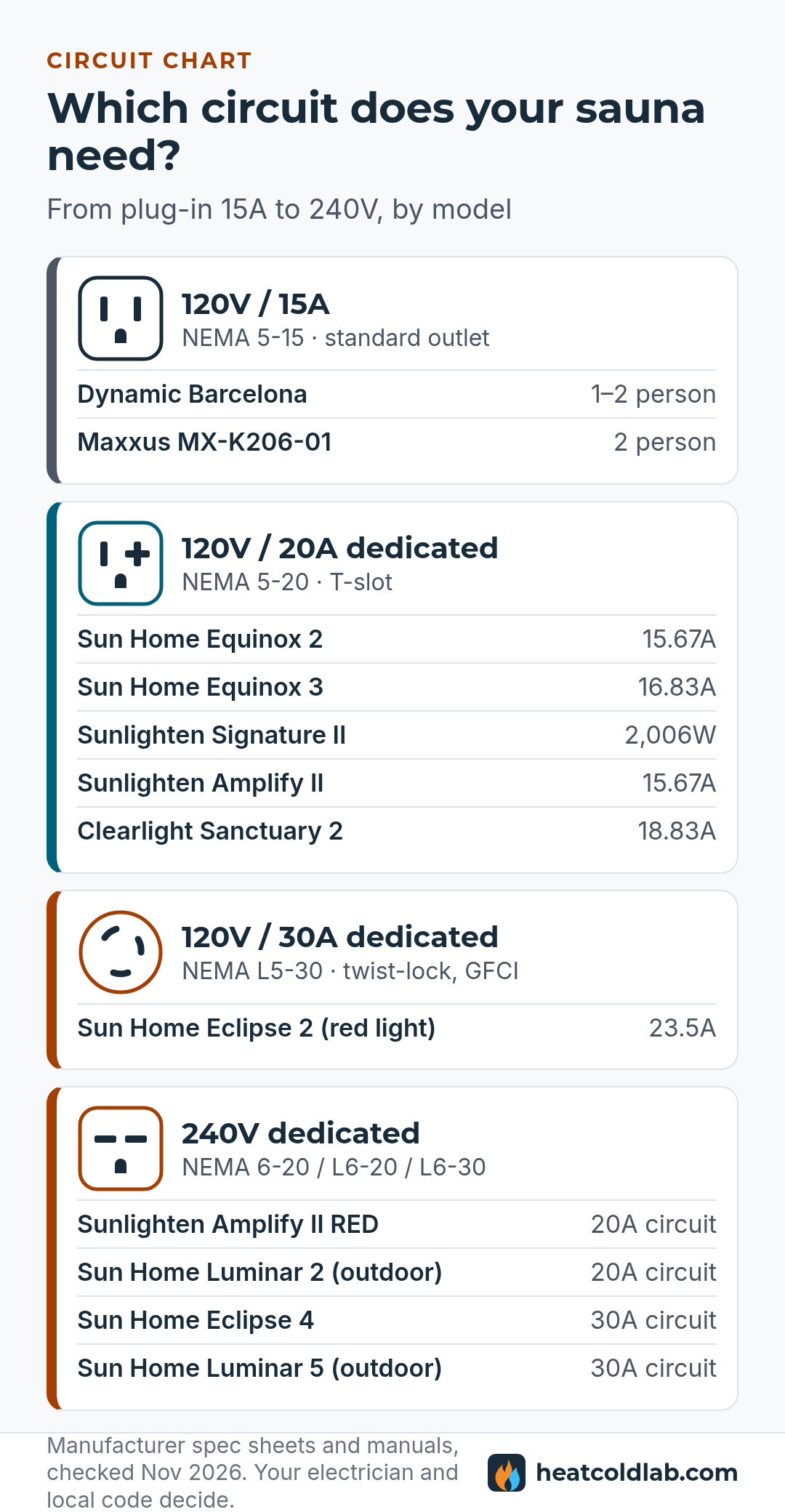
- Plug type: a NEMA code such as 5-15P, 5-20P, L5-30P, 6-20P or L6-30P. This tells you exactly which receptacle you need.
- Circuit requirement: usually “dedicated circuit required” or “dedicated outlet recommended,” sometimes with GFCI protection.
Then go to your panel. Note whether you have open slots for a new breaker (a 240V circuit needs a double-pole breaker, which takes two spaces), and estimate the wire run from the panel to the sauna location. Longer runs and finished walls drive cost.
The 80% guideline and why it matters
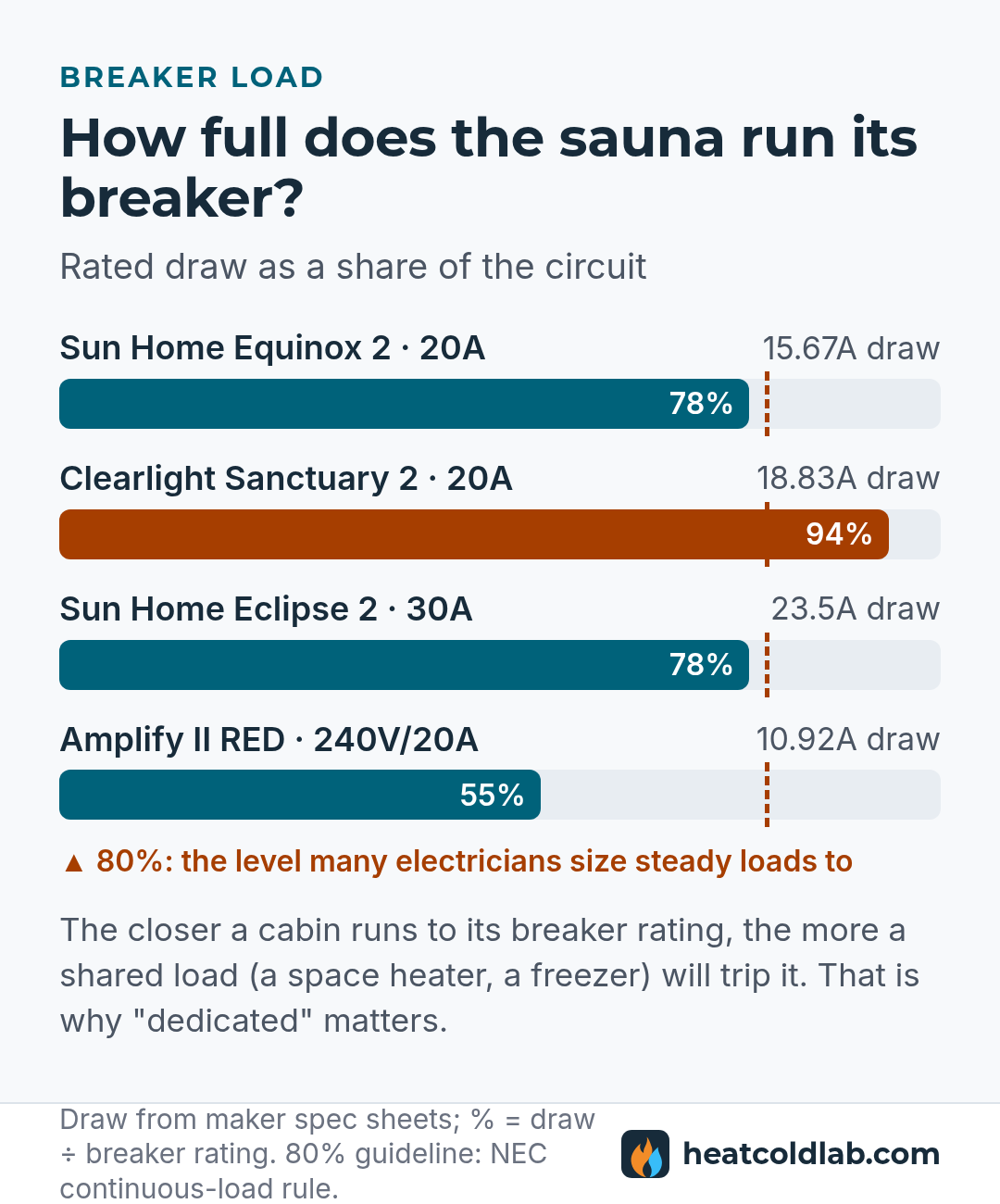
Many electricians size circuits so a heavy, steady load uses no more than 80% of the breaker rating. That comes from the National Electrical Code (NFPA 70), which requires branch circuits serving continuous loads (defined as running three hours or more) to be rated at 125% of that load. A sauna session is usually shorter than three hours, so manufacturers may rate cabins closer to the breaker’s limit. For example, the Clearlight Sanctuary 2’s 18.83A is about 94% of a 20A circuit. That is exactly why “dedicated” matters: add a space heater or a freezer to that circuit and the breaker will trip.
15A plug-in cabins (NEMA 5-15)
The standard U.S. outlet is a NEMA 5-15 receptacle on a 15A circuit, typically wired with 14 AWG copper. A few infrared saunas above $1,000 are designed for it:
| Model | Interior width | Electrical spec (manufacturer/dealer) | Price (Nov 2026) |
|---|---|---|---|
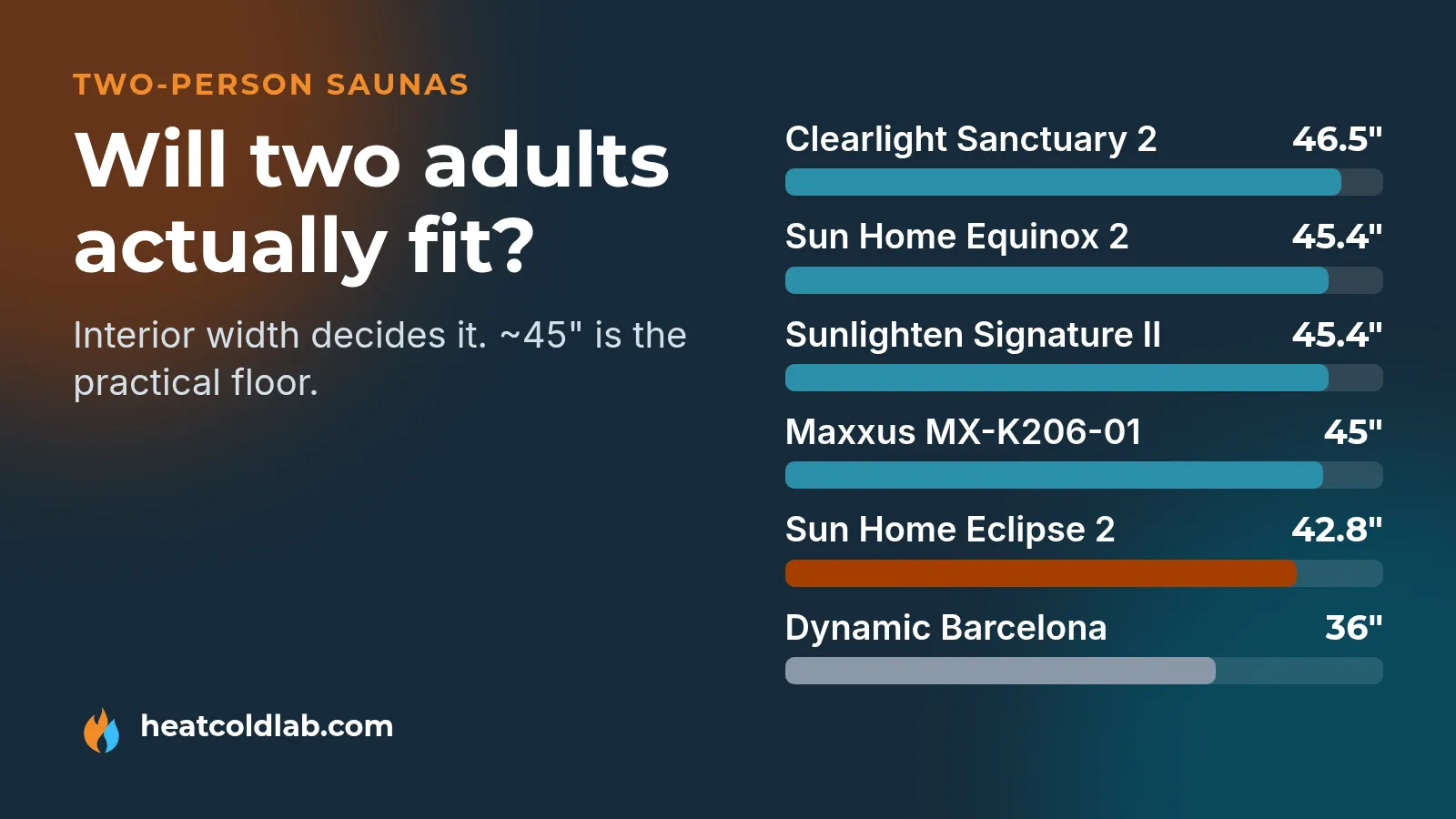
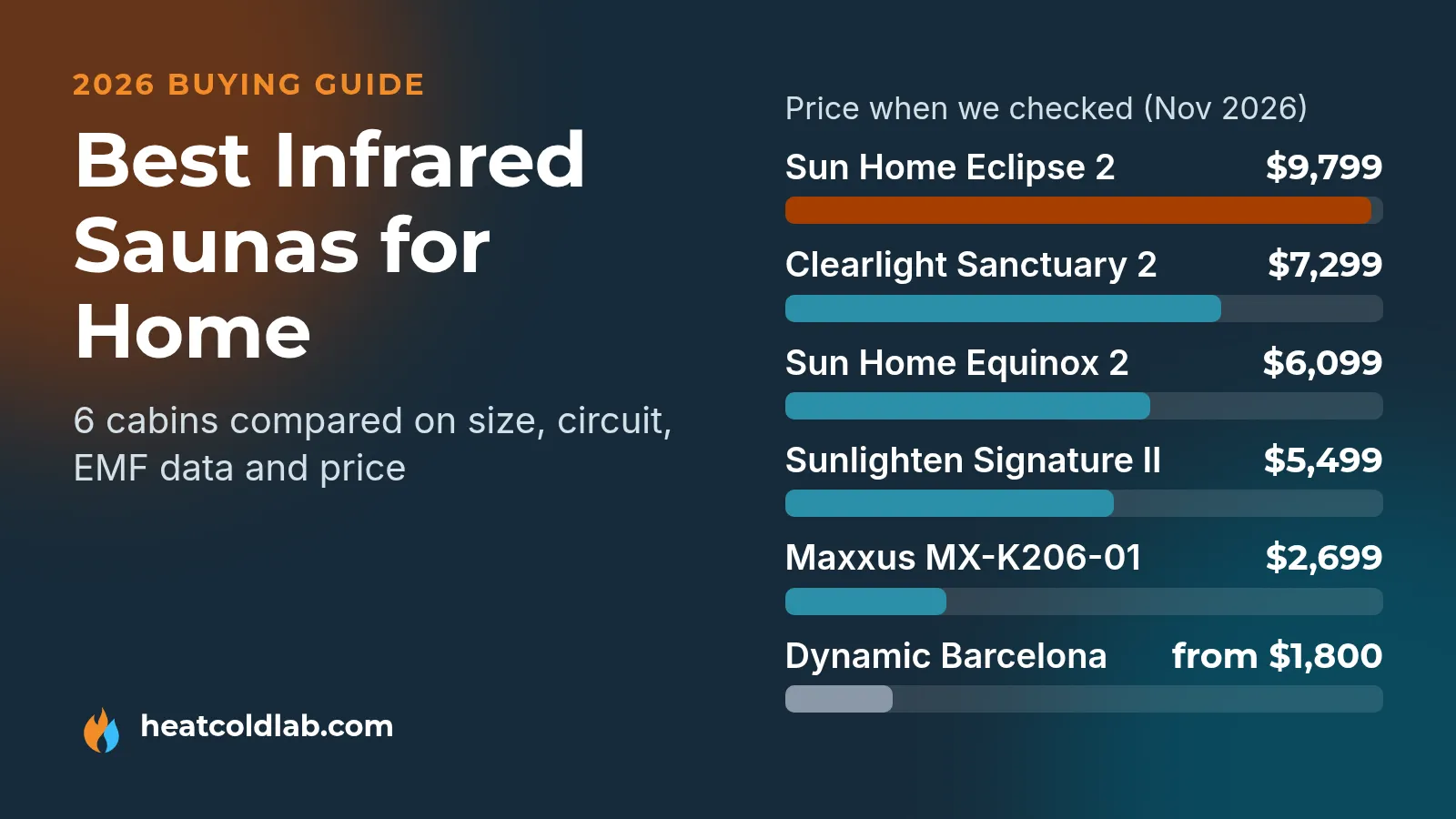
| Dynamic Barcelona DYN-6106-01 | 36” | 120V/15A, non-GFCI, plug and play, dedicated outlet recommended | around $1,800–$2,100 |
| Maxxus MX-K206-01 | 45” | 120V/15A, standard outlet (non-GFCI), dedicated outlet recommended, 9-ft cord | around $2,699 |
What to check: “plugs into a standard outlet” does not mean “share it with the treadmill.” If the outlet you plan to use shares a circuit with lights and other receptacles, you may still see trips. Bigger cabins from the same makers need more: according to Dynamic’s owner’s manuals, its 3- and 4-person models (Bellagio, Lugano, Bergamo) call for a dedicated 120V/20A circuit, and Golden Designs’ 6-person cabins need two separate 20A outlets (RecoveryLux manual summary).
Our take: if you’re torn between a 15A cabin and a 20A cabin and you’re calling an electrician anyway, run the 20A circuit. Angi prices 20A and larger dedicated circuits at about the same average, and it keeps your options open.
Spec pages: Maxxus MX-K206-01 · Dynamic Barcelona
20A dedicated circuits (NEMA 5-20)
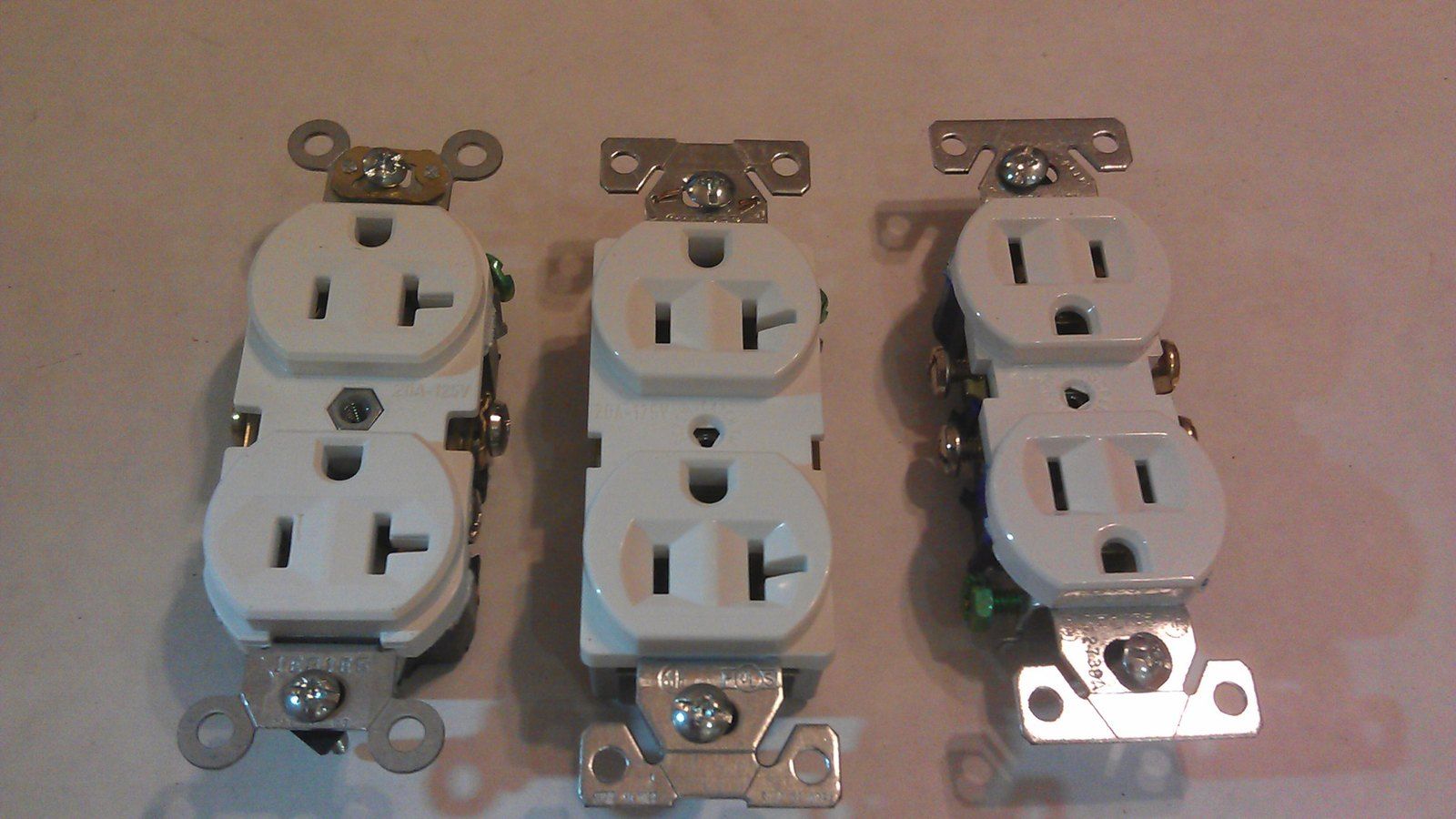
This is the most common requirement for premium two- and three-person cabins. A NEMA 5-20 receptacle looks like a standard outlet but one slot is shaped like a sideways T; a 5-20P plug has one blade turned horizontally and will not fit a standard 5-15 outlet. The circuit is typically 12 AWG copper (Clearlight’s spec sheet lists 12 AWG for its 20A saunas).
| Model | Draw | Requirement | Price (Nov 2026) |
|---|---|---|---|
| Sun Home Equinox 2 | 1,880W / 15.67A | Dedicated 120V/20A, GFCI breaker or outlet, NEMA 5-20 | around $6,099 |
| Sun Home Equinox 3 | 2,020W / 16.83A | Dedicated 120V/20A, NEMA 5-20 | around $6,999 |
| Sun Home Solstice 2 | per spec sheet | Dedicated 120V/20A GFCI, NEMA 5-20 | around $5,599 |
| Sunlighten Signature II | 2,006W | Dedicated 120V/20A, NEMA 5-20R/5-20P | around $5,499 |
| Sunlighten Amplify II | 1,880W / 15.67A | 120V, NEMA 5-20R | around $5,799–$5,999 |
| Clearlight Sanctuary 2 | 2,260W / 18.83A | 120V/20A outlet, NEMA 5-20P | around $7,299 |
Cord placement matters as much as the circuit. Sun Home’s Equinox and Solstice cords are 10 feet and exit the back-left of the roof; Clearlight’s Sanctuary 2 cord exits the roof and is about 8 feet; Sunlighten’s mPulse Believe cord exits the back-left of the base. Put the receptacle on the right side of the cabin before the drywall is patched.
Spec pages: Sun Home Equinox 2 · Clearlight Sanctuary 2
30A circuits: red light and add-ons (NEMA L5-30 and 5-30)
Built-in red light therapy adds a lot of load. The Sun Home Eclipse 2 runs at 120V but draws 23.5A (2,820W), so Sun Home requires a dedicated 30A circuit with a GFCI breaker and a NEMA L5-30 twist-lock receptacle. Clearlight’s Sanctuary 2 spec sheet offers two options if you add its CORE red light tower and want to run both at once: one 30A outlet (NEMA 5-30P, 10 AWG wire) for both, or the sauna on its 20A outlet plus a separate 15A circuit for the tower. If you also add Clearlight’s upgraded heater, only the 30A option works.
If red light is even a maybe, decide before you wire. Running a 20A circuit now and upgrading later means paying the electrician twice, and that’s the most avoidable cost on this page. Our red light sauna guide compares built-in and add-on systems.
Spec page: Sun Home Eclipse 2
240V circuits: larger cabins and outdoor models
240V cabins draw fewer amps for the same wattage, which is why makers use it for big cabins and high-output heaters. Examples from current spec sheets:
| Model | Requirement | Price (Nov 2026) |
|---|---|---|
| Sunlighten Amplify II RED | 240V, 2,620W, 10.92A; dedicated 240V/20A, NEMA 6-20R | around $7,899 |
| Sun Home Luminar 2 (outdoor) | Dedicated 240V/20A, NEMA L6-20, GFCI | around $10,799 |
| Sun Home Eclipse 4 | 240V, 22A; dedicated 30A, NEMA L6-30, GFCI breaker | around $12,799 |
| Sun Home Luminar 5 (outdoor) | 240V, 30A draw; dedicated 30A, NEMA L6-30, GFCI breaker | around $13,699 |
| Sunlighten mPulse Conquer and larger | Dedicated 240V (per dealer spec) | by quote |
A 240V circuit needs a double-pole breaker and two panel spaces. Sun Home states a licensed electrician is required for all of its 240V and 30A installations.
Outdoor saunas and “outdoor infrared sauna 120V”
People search for 120V outdoor infrared saunas because running 240V to the backyard is expensive. Some smaller outdoor cabins do run on 120V, but many premium outdoor models, including both Sun Home Luminar cabins, need 240V. Outdoors you also need a trench or conduit run, a weather-resistant receptacle with an in-use (bubble) cover, and GFCI protection. Get the trenching cost in the same quote.
Electrician cost ranges
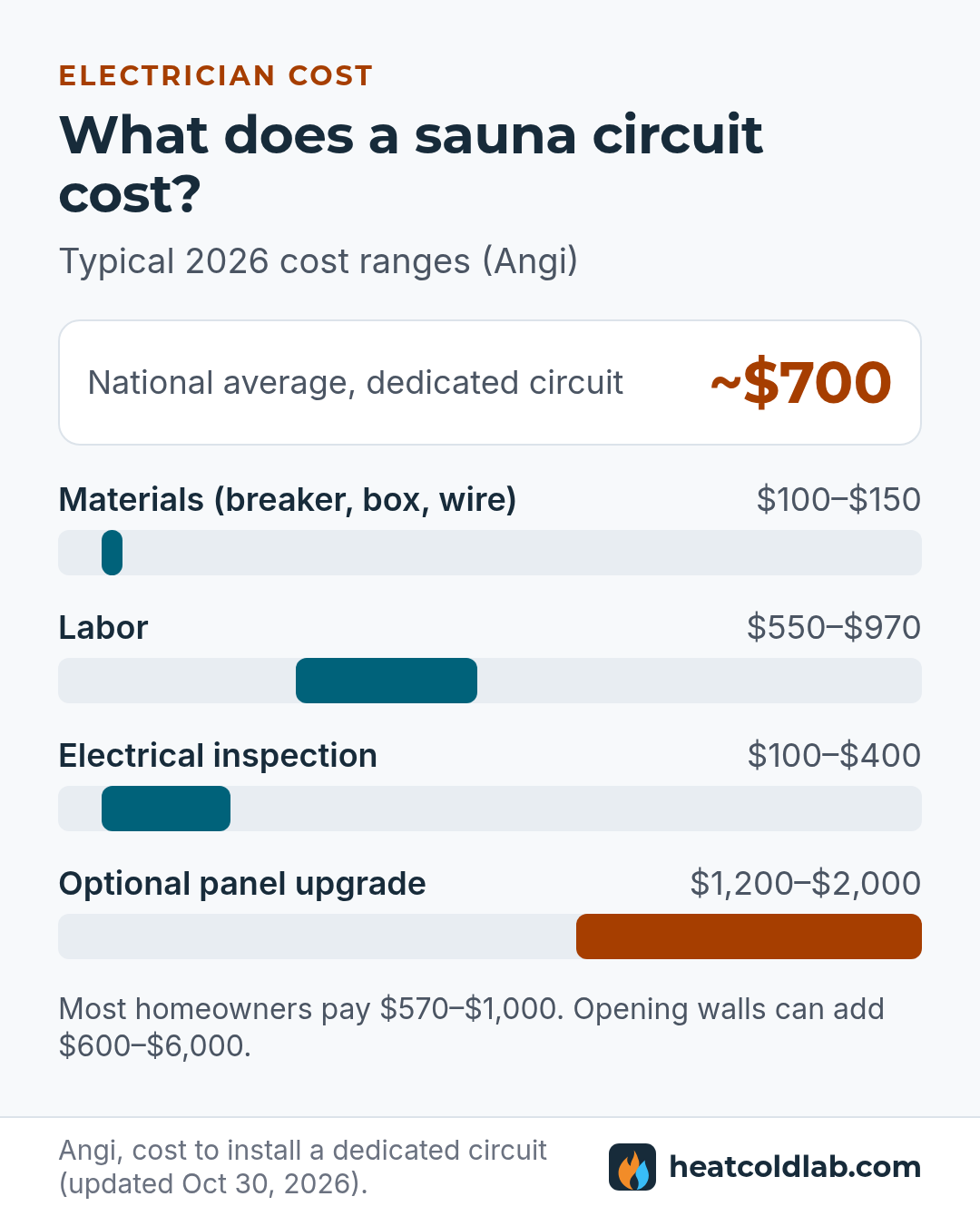
Angi’s 2026 cost guide (updated October 2026) puts the national average for a dedicated circuit at about $700, with most homeowners spending $570–$1,000. Its breakdown:
| Item | Typical 2026 cost (Angi) |
|---|---|
| Materials (breaker, box, connectors, wire) | $100–$150 |
| Labor | $550–$970 |
| Electrical inspection | $100–$400 |
| Optional panel upgrade | $1,200–$2,000 |
| Opening walls and running wire | $600–$6,000 |
Angi’s city samples ranged from about $570–$700 in Miami to $890–$1,090 in New York. Get two or three quotes, and ask each electrician to confirm the permit, the breaker type (standard, GFCI or dual-function AFCI/GFCI) and the exact receptacle.
What does it cost to run?
At an example electricity rate of 18 cents per kWh, a 1,880W cabin running at full output for one hour uses about 1.9 kWh, or roughly 34 cents. Infrared heaters cycle once the cabin reaches temperature, so real use is often lower. Sunlighten estimates its saunas typically cost 15–35 cents per hour to run, depending on model and local rates.
Warranty traps
Electrical shortcuts are one of the easiest ways to lose warranty coverage:
- Extension cords and power strips. Sun Home says no power strips or extension cords; Sunlighten states using a power strip or converter will void the warranty. Several makers also prohibit plug adapters.
- Shared circuits. “Dedicated” means no other loads on that breaker.
- Wrong plug swaps. Cutting off a 5-20P plug to fit a 5-15 outlet is unsafe and voids coverage. Install the right receptacle instead.
- Unpermitted work. Where your jurisdiction requires a permit, skipping it can create insurance and resale issues.
Step-by-step: getting the circuit right
- Find the exact spec for the model and size you are buying (an Equinox 2 and Equinox 3 have different draws).
- Pick the location with clearances in mind (Sun Home recommends 4 inches on all sides and 12 inches above).
- Measure the cord exit and plan the receptacle within reach.
- Get a written quote naming breaker size and type, wire gauge, receptacle (NEMA code) and permit.
- Install before delivery day, then plug the sauna directly into its receptacle.
If you are still choosing a cabin, compare circuits side by side in our best infrared saunas for home and best 2-person infrared saunas guides. Full-spectrum cabins can also have different power needs from far-infrared models, which we cover in full spectrum vs far infrared. And if EMF matters to you, wiring layout is part of the story; see our low-EMF guide.
FAQ
Does an infrared sauna need a dedicated circuit?
Almost always. Premium makers such as Sun Home, Sunlighten and Clearlight require a dedicated circuit, and budget makers such as Dynamic and Maxxus recommend one even for 15A models. Sharing the circuit with other loads is the most common cause of tripped breakers.
Can I plug an infrared sauna into a regular outlet?
Only if the spec sheet says 120V/15A with a standard NEMA 5-15 plug, as on the Dynamic Barcelona and Maxxus MX-K206-01. Most two-person premium cabins use a NEMA 5-20 plug that will not physically fit a standard 15A outlet.
How many amps does an infrared sauna use?
Divide watts by volts. A 1,880W cabin at 120V draws about 15.7A (Sun Home Equinox 2); a 2,260W cabin draws about 18.8A (Clearlight Sanctuary 2); the Sun Home Eclipse 2 with red light draws 23.5A at 120V. Many 240V cabins draw 11–30A.
How much does it cost to add a dedicated circuit for a sauna?
Angi’s 2026 data puts the national average for a dedicated circuit around $700, with most homeowners spending $570–$1,000. Inspections can add $100–$400, and a panel upgrade can add $1,200–$2,000 or more.
Does an outdoor infrared sauna need 240V?
Not always, but many do. The Sun Home Luminar 2 outdoor cabin requires a dedicated 240V/20A circuit with a NEMA L6-20 receptacle, and the Luminar 5 needs 240V/30A. Outdoor receptacles also need weather-resistant, in-use covers under code.
Do I need GFCI protection for an infrared sauna?
Check both your local code and the manufacturer. Sun Home requires GFCI protection on every model’s circuit (a GFCI breaker for its 30A and 240V models), while Dynamic and Maxxus specify non-GFCI 15A outlets for some cabins. Your electrician should reconcile the two.
Sources
- Sun Home: Equinox electrical specs, Full-spectrum collection electrical requirements, Eclipse user guide, Solstice 2
- Sunlighten: Signature II, Amplify II, Amplify II RED, mPulse Believe spec sheet (PDF)
- Clearlight: Sanctuary 2 product page, Sanctuary 2 spec sheet with CORE Tower wiring options (PDF)
- Maxxus: Sun Valley Saunas listing
- Dynamic: Wellness Matrix USA, RecoveryLux: electrical requirements by model, from owner’s manuals
- Angi: Cost to install a dedicated circuit (updated Oct 30, 2026)
- National Electrical Code (NFPA 70): continuous-load definition (Article 100) and branch-circuit sizing for continuous loads (Section 210.19/210.20)
- Hero photo: “US Outlet Receptacle 20, 20 and 15 amp” by Jeremy Morris, Wikimedia Commons, CC BY-SA 3.0 (cropped)